




Plant growth detection is an important task in fields such as ecology, forestry, and agricultural science and technology. In order to accurately grasp the growth patterns of plants, understand their growth mechanisms, and provide scientific basis for plant cultivation and agricultural management, the application of modern technological means such as linear displacement sensors is particularly important. This article will elaborate in detail on the application cases of linear displacement sensors in plant growth detection, demonstrating their advantages of high precision, reliability and automated measurement.

A linear displacement sensor is a high-precision measuring device capable of measuring the variation of an object in the horizontal or vertical direction relative to a certain reference point. Its working principle is based on different physical effects, such as the potentiometer principle and resistance changes, and it can record the displacement changes of objects in real time and accurately. In plant growth detection, linear displacement sensors are mainly used to measure growth parameters such as the diameter at breast height, height and fruit size of trees, crops and other plants.
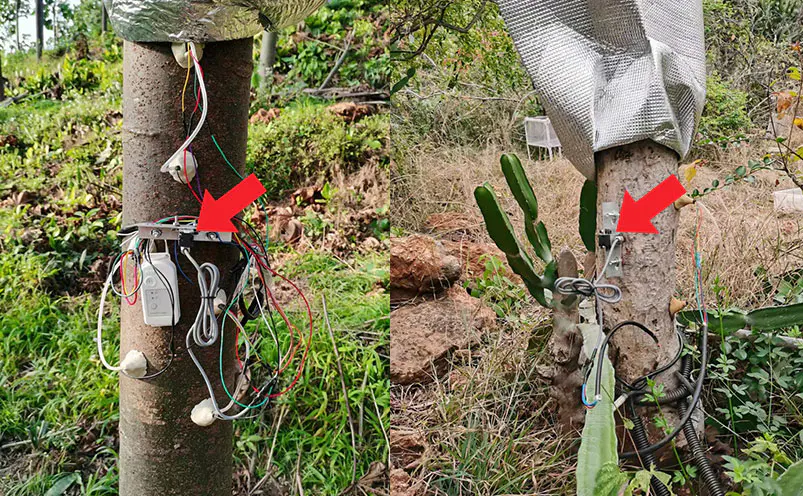
Application process
Data acquisition: Linear displacement sensors are installed at the diameter at breast height of the trees to measure and record in real time the minute changes in the tree's diameter. The analog signal output by the sensor can be stored.
Data analysis: Through the accompanying software, data is imported into the computer to generate charts or continuous curve graphs, presenting the growth trend and cycle patterns of tree diameters. These data can be used to study the impact of factors such as soil, rainfall, fertilization, and pests and diseases on tree growth.
This system has achieved automated and high-precision measurement of tree diameter growth, significantly reducing the cost of forest surveys and enhancing the efficiency and accuracy of data collection. By long-term monitoring of the growth and changes in tree diameters, the growth patterns of forest trees can be more accurately grasped, providing a scientific basis for forest ecosystem ecology or forestry management.
In addition to monitoring the diameter growth of trees, linear displacement sensors are also widely used in the growth detection of other plants. For instance, in the monitoring of crop growth, linear displacement sensors can be used to measure the changes in plant height of crops to assess their growth rate and growth condition. In addition, in fruit tree cultivation, linear displacement sensors can be used to monitor the size changes of fruits, providing data support for the cultivation management and fruit picking of fruit trees.
The application of linear displacement sensors in plant growth detection demonstrates their advantages of high precision, reliability and automated measurement. By monitoring the growth parameters of plants in real time, the growth patterns of plants can be more accurately grasped, providing more scientific and efficient data support for fields such as plant cultivation, agricultural science and technology, and forestry management. With the continuous development of sensor technology and computer technology, the application prospects of linear displacement sensors in plant growth detection will be even broader.